In the world of real estate development, time kills deals. The clock on your public comment window doesn't start until your sign is posted correctly.
We know that DPD (Department of Planning and Development)—now often SDCI—and Land Use Action signs are more than just plywood and paint. They are a critical regulatory step. If the font is wrong, the setback is off, or the install date is missed, your project timeline slips.
At Big Bass Signs, we treat your public notice requirements with the urgency they deserve. We are the communicative, transparent partners who ensure your entitlement process hits the ground running.
As of 1/26 these are accurate - but we check prior to every single job to ensure compliance.
Every jurisdiction has its own "tackle box" of rules. A sign that passes in Seattle might fail in Mount Vernon. Here is how we navigate the specific regulations in your county:
The Standard: The "White Board."
The Look: typically large 4’ x 8’ signs on MDO plywood.
The Rules: Seattle (SDCI) is strict. The "Land Use Information" header must be specific, the font must be Helvetica, and the layout must match their digital template exactly.
Cities: Bellevue, Redmond, Kirkland, Shoreline, Kent, Renton, Federal Way, Auburn, Sammamish
Our Edge: We use high-durability materials that resist graffiti—a common issue in King County that can force you to replace signs mid-process. Our replacement rates are fast and reasonable.
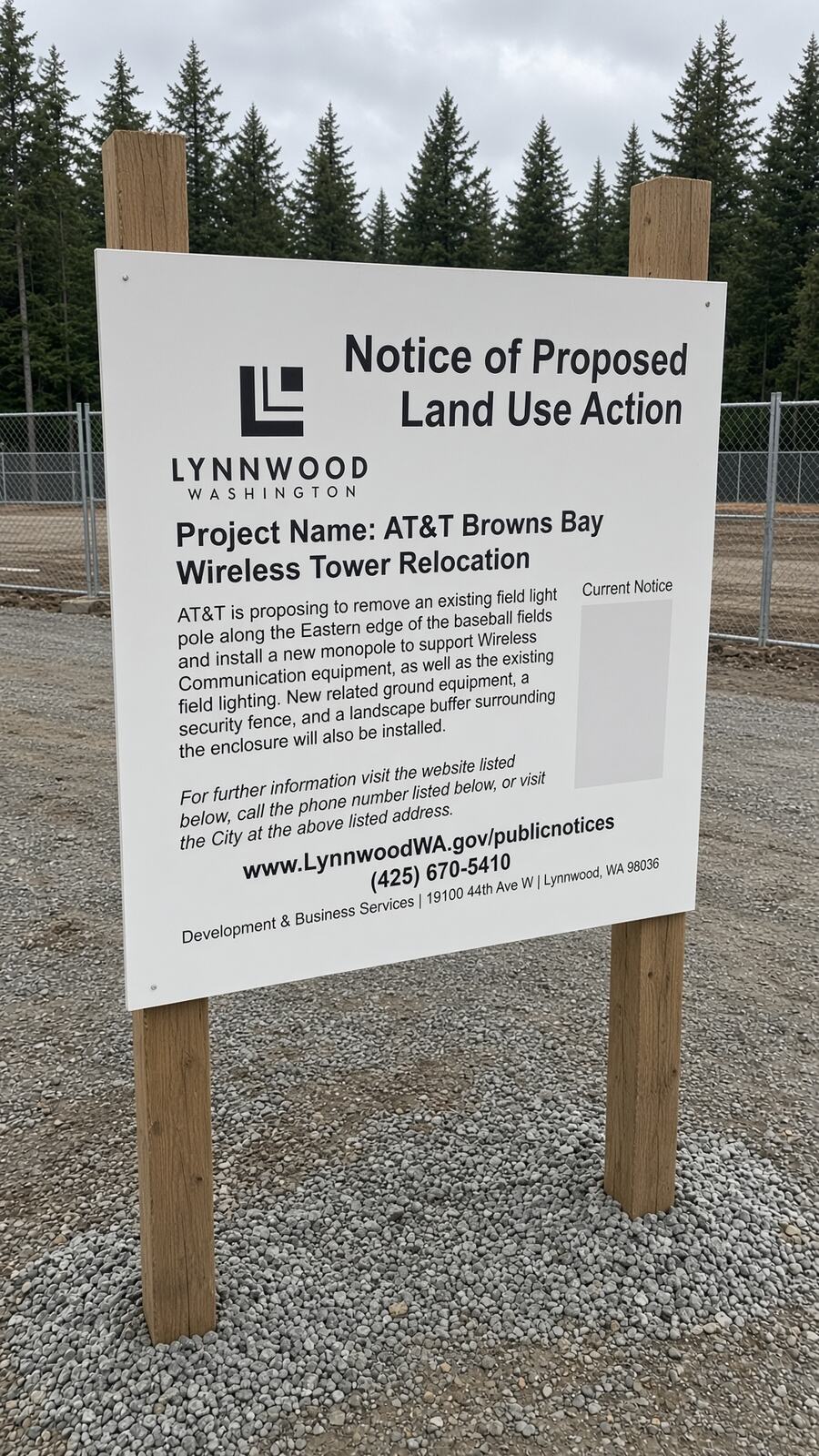
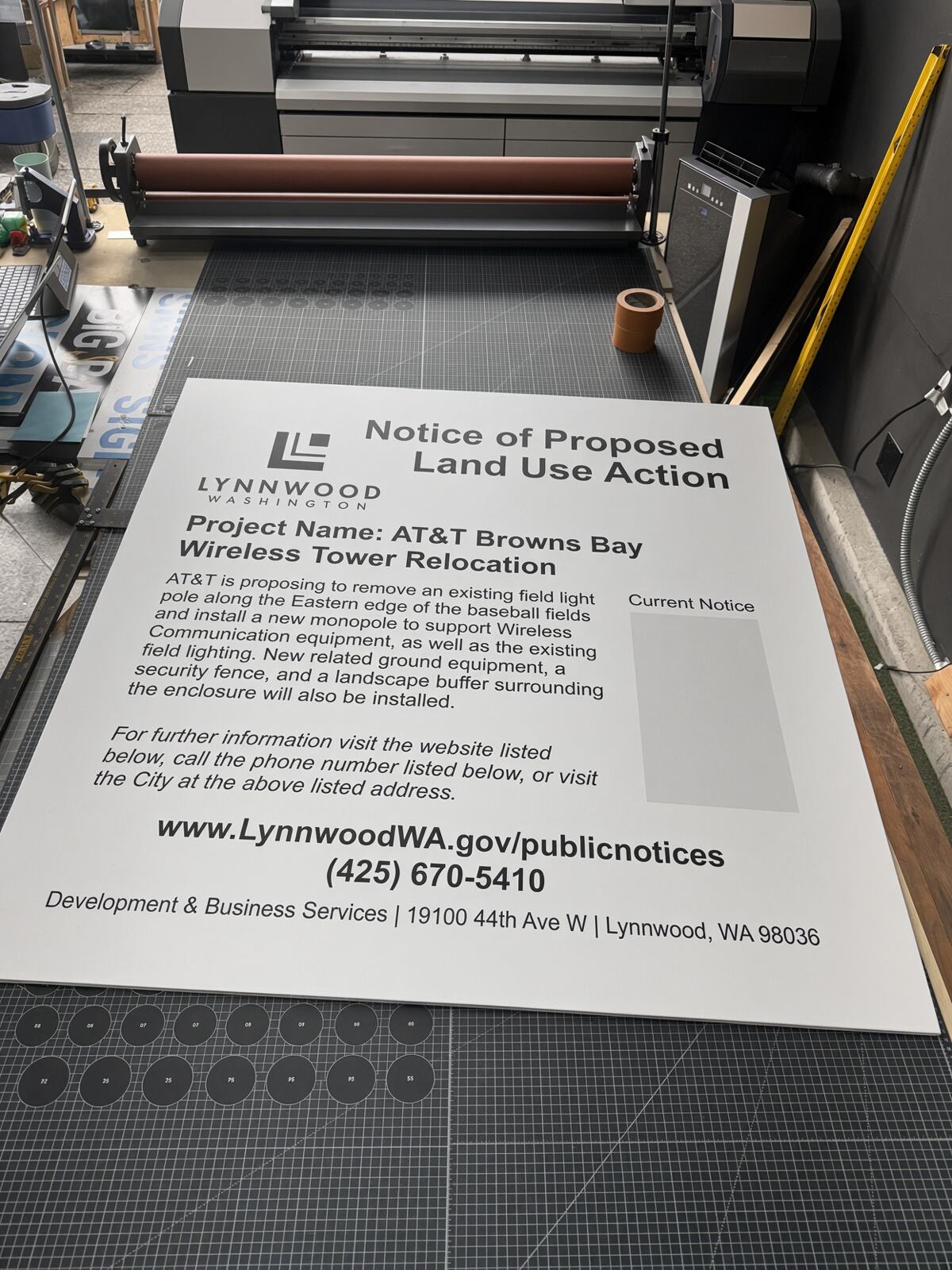
The Standard: "Proposed Land Use Action."
The Look: Focus on high visibility from the Right of Way (ROW).
The Rules: Snohomish County is serious about setbacks. Signs typically must be 5 feet from the property line and ensure they don't block sight triangles at intersections.
Cities: Everett, Marysville, Edmonds, Bothell, Lynnwood, Mukilteo, Arlington, Granite Falls, Monroe, Lake Stevens, Snohomish
Our Edge: Our install teams are trained to identify the correct property lines and ROW setbacks, ensuring your sign is visible to the public but safe from code enforcement removal.
The Standard: The "Blue & White."
The Look: Unlike the massive Seattle boards, Skagit often utilizes specific 24" x 30" signs.
The Rules: These must be Royal Blue and White. They are required to be posted on each street frontage of the affected property.
Cities: Mount Vernon, Anacortes, Sedro-Woolley, Burlington
Our Edge: We stock the specific Royal Blue required for Skagit compliance, ensuring you don't get flagged for using the wrong shade or size.
The Standard: "The Yellow Board."
The Look: Unlike its neighbors to the north, Pierce County often requires high-visibility Yellow backgrounds with black lettering for Land Use Action signs.
The Rules: Code 18B is strict about placement. Your sign generally needs to be 4’ x 8’ and positioned carefully to avoid the "clear vision" triangle at intersections. If you put a white sign where a yellow one is required, you will be re-printing and re-posting.
Cities: Tacoma, Puyallup, Sumner, Fife, Edgewood, DuPont, Graham, Gig Harbor
Our Edge: We stock the specific "Pierce County Yellow" material. We also know the specific mounting height requirements to ensure your sign is readable from the roadway without violating traffic safety codes.
The Standard: "The Island Logistics."
The Look: Typically white 4’ x 8’ plywood boards (Type II & III decisions), but the real challenge isn't the paint—it's the placement.
The Rules: In island jurisdictions, visibility is key. Signs must be readable from the abutting public road, often requiring creative installation solutions on rural, brush-heavy lots.
Cities: Stanwood/Camano, Oak Harbor, Coupeville, Langley
Our Edge: We handle the ferry. You don’t need to send a project manager on a day-long trip to Orcas or Whidbey just to plant a post. We factor ferry logistics and high-wind structural requirements into our quote. Our signs are built to withstand the gale-force winds coming off the Sound so your notice doesn't end up in the neighbor's yard.
The Standard: "The North End Notice."
The Look: Standard 4' x 8' white background with black lettering, but with heavy emphasis on specific content headers like "Notice of Land Use Application."
The Rules: Whatcom requires the site to be clearly flagged before inspection. The sign often acts as the landmark for the planner. If the sign isn't visible from the Right of Way (ROW) or if the site isn't flagged, you fail inspection.
Cities: Bellingham, Blaine, Everson, Ferndale, Lynden, Nooksack, Sumas
Our Edge: We coordinate the sign installation with your flagging schedule. We double-check the ROW setbacks (typically 5+ feet) to ensure the snowplows don't take it out in winter and the planners can find it in summer.
The Standard: "East of the Mountains."
The Look: While the layout is often standard, the construction must be different.
The Rules: Chelan’s setbacks are dictated by the slope of your lot. The steeper the lot, the different the setback calculation.
Cities: Cashmere, Chelan, Entiat, Levenworth
Our Edge: Weatherproofing. A sign in Leavenworth or Wenatchee faces different elements than a sign in Seattle. We use UV-resistant inks that won't fade under the harsh Eastern Washington sun and reinforced posts to handle heavy winter snow loads. We ensure your sign is still standing when the snow melts in spring.
The Standard: "The Design District Detail."
The Look: While standard Land Use Notice signs are typically the familiar white 4’ x 8’, Kitsap throws a curveball with its Design Districts. If your project is in Silverdale, Kingston, or Keyport, the visual standards change.
The Rules: Kitsap is strict about the Right of Way (ROW). You cannot simply drive a stake anywhere. Signs must be legible from the road but cannot impede pedestrian traffic or sightlines.
Cities: Bremerton, Port Orchard, Bainbridge, Poulsbo
Our Edge: We know the Districts. We check if your parcel falls within a specific Design District overlay before we print. We also use specific mounting systems that satisfy Kitsap's strict "no wire stakes" policy for ROW signage—ensuring your sign stays up without getting flagged by the County Engineer.
The Standard: "The High Country Code."
The Look: Standard land use signs apply, but if you are dealing with sensitive environments (which is common here), you may need the specific Green & White "Critical Area" markers.
The Rules: This is where the amateurs fail. Kittitas County has specific structural requirements for signs over 7 feet tall. They often require post holes dug into native soil—specifically banning the use of certain sono-tubes for stability in some contexts.
Cities: Ellensburg, Cle Elum, Kittitas, Roslyn
Our Edge: Snow Load & Soil. We don't just plant a sign; we build a structure. We understand the wind and snow loads in Ellensburg and Cle Elum. We dig the post holes to code-required depth so your sign doesn't topple in the first winter gust or get rejected by a building official for improper footing.
Speed: We know you need to "get the clock started." Our turnaround times are designed to meet tight application windows.
Accuracy: We stay up-to-date on code changes so you don't have to.
Full Service: From layout and fabrication to code-compliant installation and removal.